Traffic
Professional HTTP history with Argus context.
Filter, inspect, highlight, replay, and analyze captured traffic without leaving the workbench.
AI-assisted web application security testing
A DAST, proxy, and AI workbench for security teams that need authenticated coverage, readable traffic, reproducible AI tasks, HTTP comparison, and findings backed by evidence.
Built for security professionals
Argus turns traffic, findings, notes, cookies, scope, request bodies, response bodies, and comparison data into reproducible AI tasks. The result is faster triage without losing the proof trail.
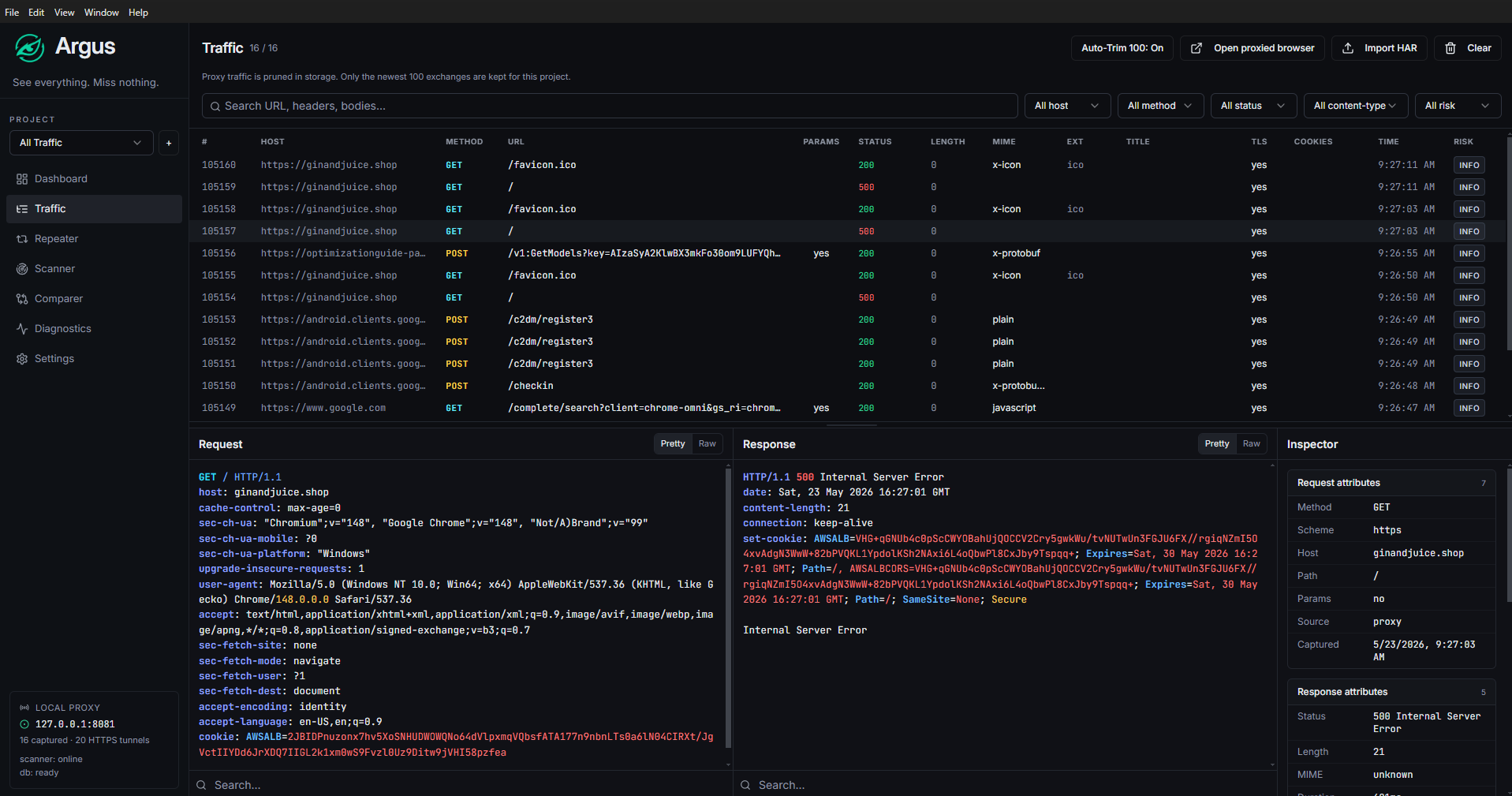
Traffic
Filter, inspect, highlight, replay, and analyze captured traffic without leaving the workbench.
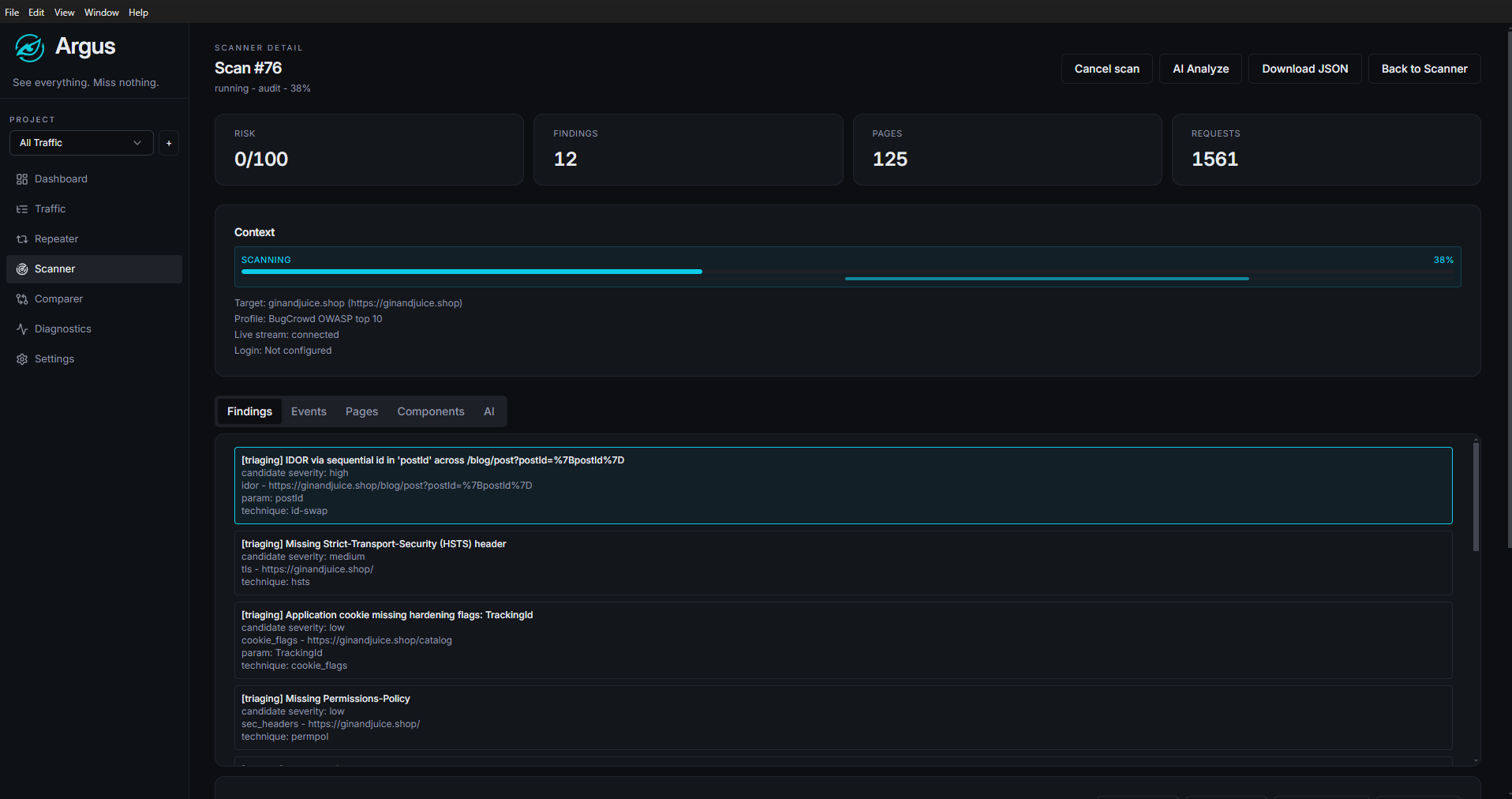
Scanner
Queue scans, confirm login status, watch events, and review findings with coverage context.
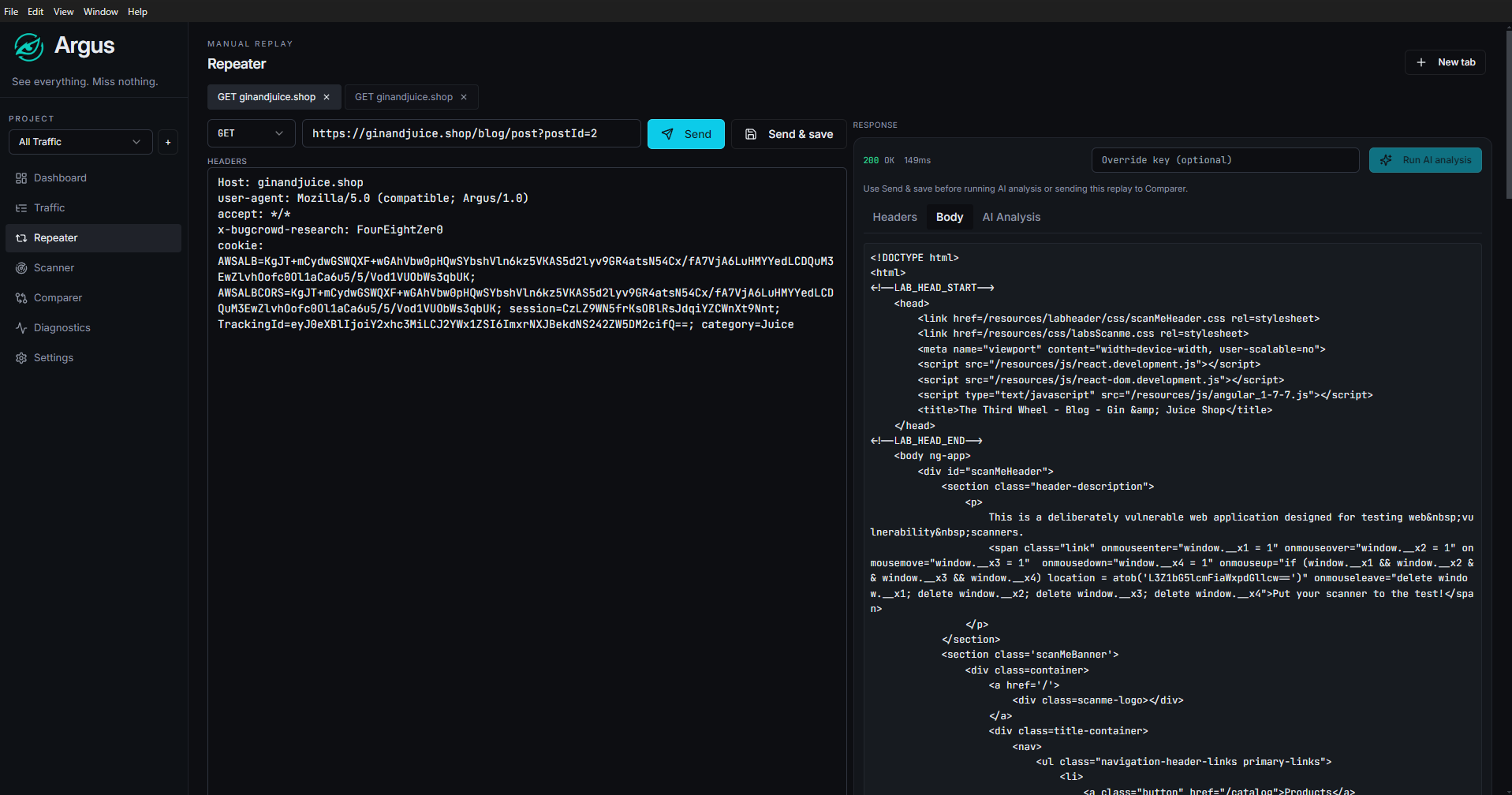
Repeater
Send requests from traffic or findings, edit them, rerun them, and ask AI to analyze the exact request, response, notes, cookies, and scope.
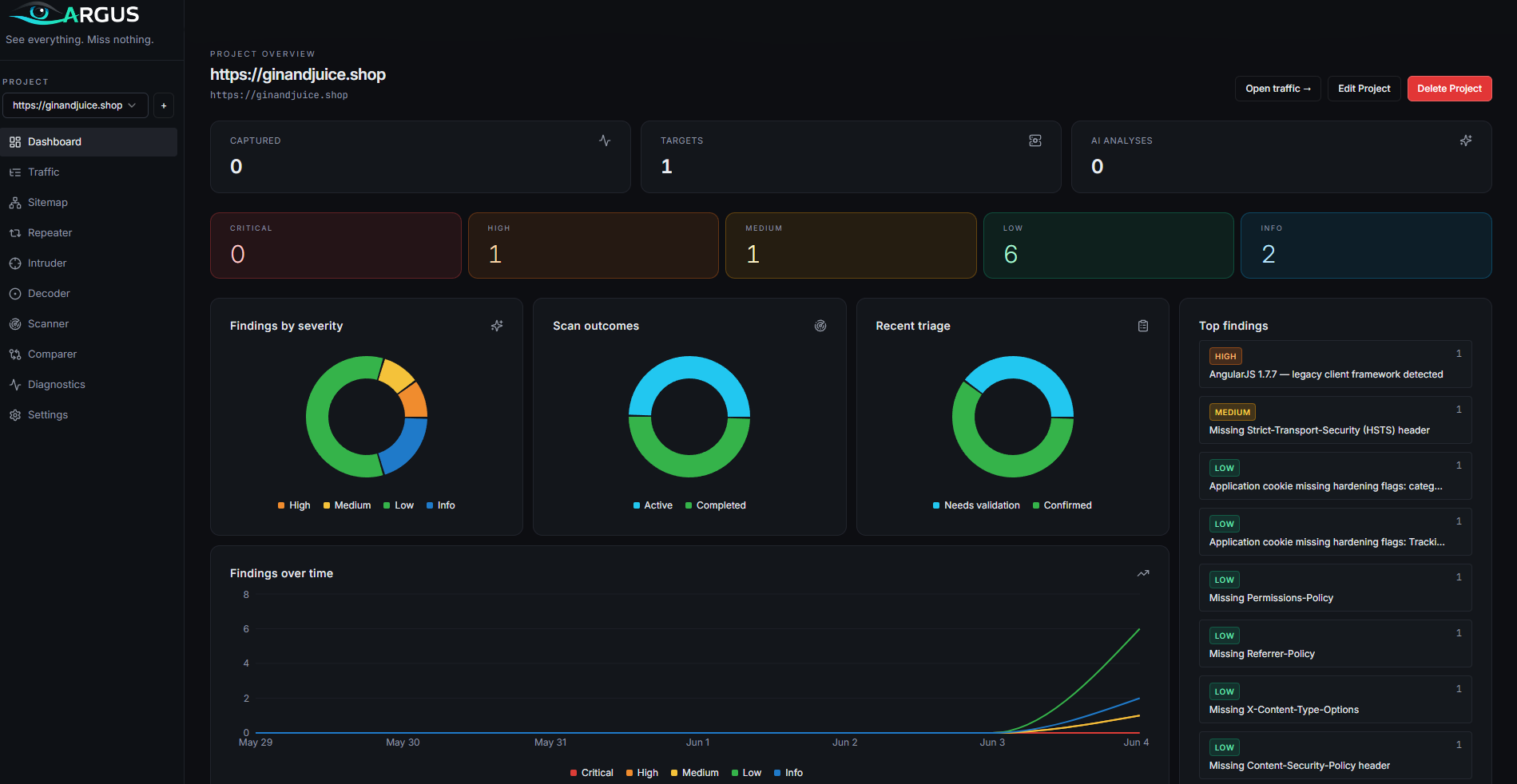
Dashboard
See scan posture, finding trends, top recurring issues, and quick launch controls in one clean work surface.
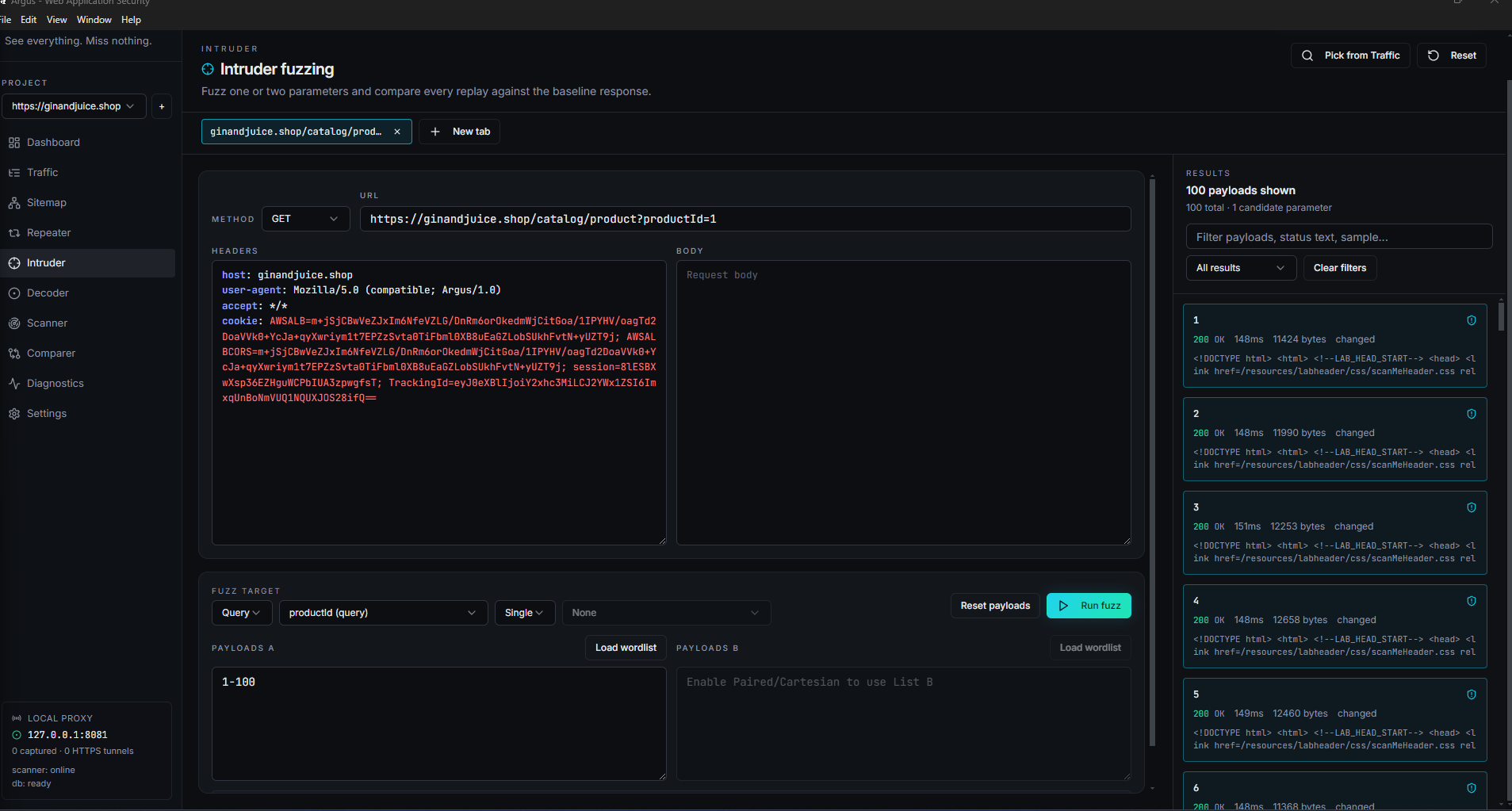
Intruder
Seed requests from traffic, sitemap, or repeater, fuzz parameters with controlled payloads, and pivot the interesting hits back into manual replay.
Configure form, multi-step form, cookie, and header auth at the target level. Argus records whether login succeeded before trusting authenticated results.
Capture browser and scanner traffic, filter by host, method, risk, and content type, then send requests directly to Repeater for manual validation.
Findings are calibrated against baseline responses, block pages, deletion cookies, and generic client-side markers to reduce noisy false positives.
Every AI run stores selected context, loaded exchange IDs, model output, follow-up steps, and linked findings so the analysis can be reviewed later.
Limit pages, depth, concurrency, URL signatures, and static assets so large targets produce usable coverage instead of infinite crawl noise.
Diff requests, responses, headers, and bodies side by side to prove behavioral changes, isolate noise, and document exactly what changed.
AI workflows
Prompt against the exact exchange you are testing. Argus records which context chips were used, the saved request ID, the model decision, and the linked AI finding.
Use AI to propose validation checks, compare baselines, explain false-positive cautions, and decide whether a finding should be confirmed, downgraded, or kept pending.
Findings can carry AI verdicts with severity, confidence, evidence assessment, validation notes, reportability, and remediation guidance.
Bring your own OpenAI API key so your team decides which models to use, keeps usage tied to your account, and avoids hidden AI markups.
Argus has the request, response, affected URLs, extracted data, steps, and AI triage context available when it is time to write a professional finding.
Workflow
Add authorized targets, auth details, scan intensity, crawl budgets, and proxy behavior.
Use the proxied browser and traffic history to observe the app as users and scanners see it.
Run active checks with concurrency, jitter, WAF awareness, and deduplication tuned per target.
Inspect requests, replay variants, review AI analysis, and promote only evidence-backed findings.
Comparer
Security testing often comes down to proving that two responses are meaningfully different. Argus Comparer gives you a focused side-by-side diff for requests, responses, headers, and bodies.
HTTP/1.1 200 OK
content-type: application/json
date: Mon, 25 May 2026

{"status":"ok","daystart":83380}
HTTP/1.1 200 OK
content-type: application/json
date: Mon, 25 May 2026

{"status":"ok","daystart":84338}
Coverage with accountability
Argus records crawl and scan limits, skipped URL reason codes, block-page observations, deduplicated signatures, and whether a report is complete or partial.
Reporting
Differential login behavior indicates authentication bypass through a crafted email parameter. Evidence includes baseline, payload, response comparison, and replayable request data.
Why it matters
AI and scanner logic can downgrade public object access, block pages, deletion cookies, and unchanged SSRF probes instead of inflating noise.
Repeater, traffic history, and comparer keep professionals in control when a finding needs proof rather than blind automation.
AI tasks store their inputs, outputs, and linked findings so every recommendation can be traced back to the evidence.
Access
Full product access for authorized testing, evaluation, and workflow fit.
For consultants, independent researchers, and internal security engineers.
For teams standardizing DAST, triage, and report production.
Account
Start a 7-day trial with your work email. Already have access?
Your Argus account is the same identity used by the desktop app. After signup, the app checks your account before enabling licensed workflows.
Argus Software